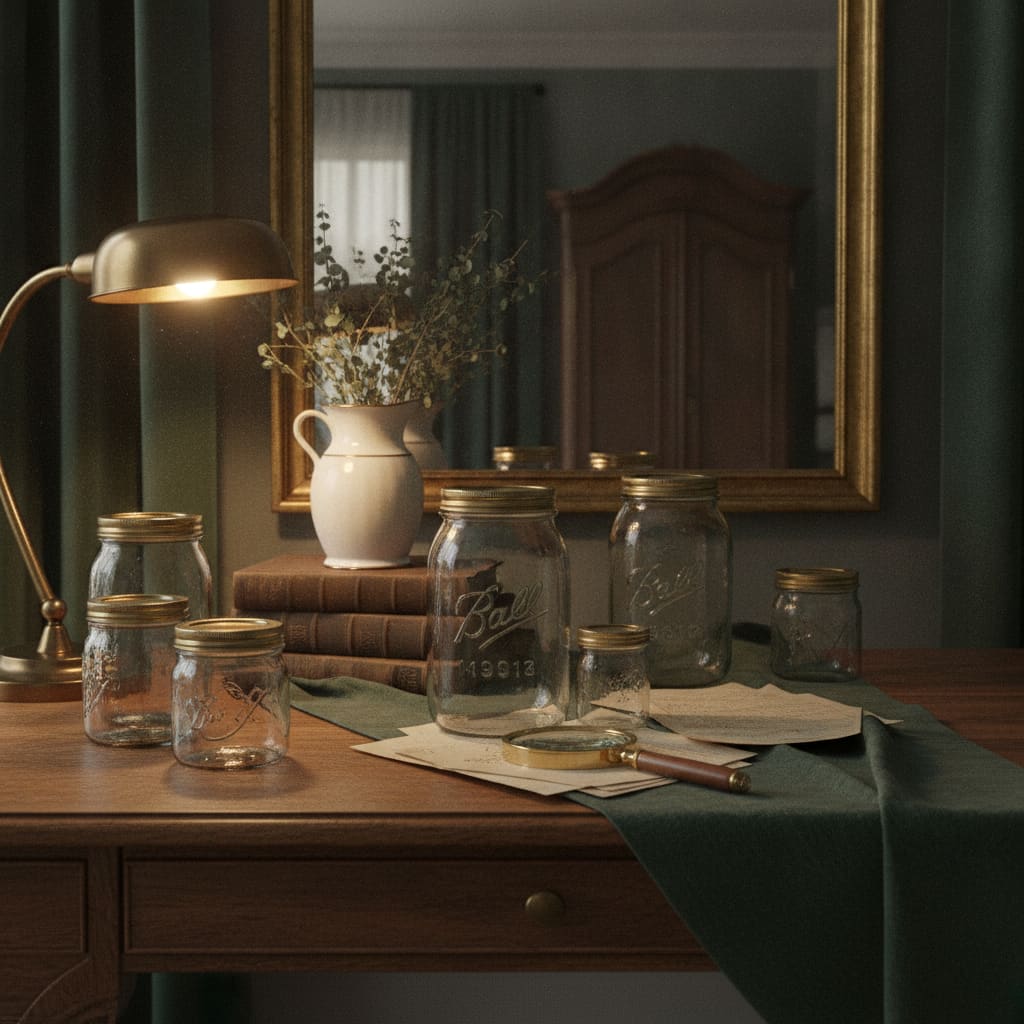
Ball mason jars are one of the few antiques you can date within a decade or two using nothing but the embossed logo on the front. The Ball Brothers Glass Manufacturing Company changed its script logo repeatedly between the 1880s and the 1960s, and collectors have mapped each version to a production window. Add glass color, closure type, and base marks, and you can usually narrow a jar's age before you leave the flea market table.
Why Ball Jars Are So Easy to Date
Ball began making fruit jars in Buffalo, New York in the mid-1880s before moving to Muncie, Indiana in 1887, where natural gas made glass production cheap. As the company grew into the dominant American canning jar maker, its embossed logo evolved from plain block letters into the famous flowing cursive — and each redesign left a datable fingerprint on millions of jars.
Two important caveats before you use any logo chart. First, the date ranges are approximate: molds stayed in service for years, and transitional logos overlap. Second, the logo dates the mold, not necessarily your exact jar — but for a mass-produced item, a ten-to-fifteen-year window is excellent precision.
One myth to retire immediately: the large number embossed on the base of many Ball jars is a mold number, not a date and not a rarity code. A "13" on the bottom does not make a jar valuable, despite the persistent story that superstitious moonshiners smashed them.
Ball Logo Dating Chart
Match your jar's embossing to the closest description. Ranges are approximate and based on collector consensus for Ball's main production lines.
| Approximate era | Logo style | Key identifying traits |
|---|---|---|
| c. 1885–1886 | "BBGMCo" monogram | Buffalo-era block monogram; rare "Buffalo jars" |
| c. 1892–1896 | Block "BALL" | Plain upright capital letters, no script |
| c. 1895–1896 | First cursive | Slanted script, no underline loop; short transition period |
| c. 1896–1910 | "Triple L" cursive | Script appears to have three loops; underline tail from the final L |
| c. 1910–1923 | Ball Perfect Mason, early | Cursive Ball with underline; "PERFECT MASON" in block letters below |
| c. 1923–1933 | Dropped-"a" cursive | The connecting stroke into the "a" fades; underline remains |
| c. 1933–1962 | Modern cursive | Cleaner script; later jars lose the underline entirely |
If the jar says "Ball Ideal" with a wire bail closure, most date from the 1910s through the 1950s; jars with a patent date of July 14, 1908 embossed on them were made for years after that date — a patent date is always an "earliest possible" marker, never a production date.
Dating by Glass Color
Color is the second-strongest clue, and it also drives value more than age does.
| Color | Typical era | Collector notes |
|---|---|---|
| "Ball blue" (aqua-blue) | c. 1910–1937 | Made from Lake Michigan sand; the classic collectible color |
| Aqua / light green | c. 1885–1910 | Earlier chemistry; common on pre-Perfect Mason jars |
| Clear | c. 1930s onward | Standard for later production; usually modest value |
| Amber / brown | scarce, mostly pre-1920 | Genuinely uncommon; verify against reproductions |
| Olive, citron, cornflower | scarce | Off-shade batch variations command premiums |
Be aware that irradiated and artificially "purpled" jars circulate widely. Manganese-decolorized glass turns amethyst under prolonged UV exposure, and some sellers accelerate this deliberately — purists consider altered color damaged, not enhanced.
Closures and Base Marks
The sealing system narrows dates further:
- Wax-seal grooves — the earliest system, mostly pre-1900.
- Lightning-style wire bails ("Ball Ideal") — roughly 1900s–1950s.
- Zinc screw caps with milk-glass liners — the standard for Perfect Mason jars; the liner often reads "Genuine Zinc Cap for Ball Mason Jars."
- Two-piece metal lid and band — the modern system, dominant after the 1930s–40s.
On the base, rough disc-shaped scars suggest earlier mouth-blown production, while suction scars (a feathered circular mark) indicate the Owens automatic bottle machine, which Ball adopted in the 1910s. Smooth, machine-made bases with valve marks are later still.
Ball's Other Lines: Ideal, Improved, Special, and Eclipse
"Perfect Mason" is the jar everyone knows, but Ball ran several parallel product lines, and the line name helps with dating too.
- Ball Ideal — the wire-bail jar with a glass lid, made from the early 1900s into the 1960s. The commemorative blue Ideal reproductions of the 1970s ("Bicentennial" jars) confuse many sellers; genuine early Ideals have period-correct logos from the chart above.
- Ball Improved — a transitional line from roughly the 1890s to 1930s using a glass lid held by a screw band. Often found in aqua with early script logos.
- Ball Special — a wide-mouth variant introduced around 1910, later renamed Special Wide Mouth.
- Ball Eclipse — a lightning-seal jar of the 1920s–1950s, usually clear glass.
- Ball Sure Seal — bail-closure jars from roughly the 1910s–1920s, typically in Ball blue.
A line name that doesn't match its logo era — say, a "Perfect Mason" with a modern underline-free script but claims of an 1890s date — is your cue that a seller is guessing.
Watch for Reproductions and Fantasy Jars
Ball jars are common enough that outright fakes are rare, but three categories trip up new collectors:
- Commemorative reissues — Ball itself released blue anniversary jars (notably in 2013–2017 for its centennial series). They're marked as such, but the blue color fools casual sellers into calling them antique. The glass is a brighter, more uniform blue than true Ball blue.
- Altered color — as noted above, purple "sun-colored" jars are usually manganese glass artificially irradiated. Genuine deep amber, olive, and cornflower jars have documented production history; neon shades do not.
- Married closures — a genuine old jar with a reproduction zinc lid or bail. The jar's value stands on its own, but "all original" pricing should require period-correct closures with honest wear.
When in doubt, weigh the whole package: logo era, color chemistry, base scars, and closure should all tell the same story. Any mismatch means at least part of the story is wrong.
What Ball Jars Are Actually Worth
Most Ball jars are common — they were produced by the hundreds of millions. Value concentrates in early logos, scarce colors, unusual sizes, and error jars. The ranges below reflect typical asking prices in collector markets for jars in undamaged condition; treat them as educational estimates, not appraisals.
| Jar type | Typical range |
|---|---|
| Clear Perfect Mason, quart, 1930s+ | $2–8 |
| Ball blue Perfect Mason, quart | $8–20 |
| Ball blue half-gallon or pint | $12–35 |
| Triple-L era aqua jars (1896–1910) | $20–60 |
| Amber or olive jars | $75–300+ |
| Upside-down (error) Ball jars | $200–1,000 |
| Buffalo-era BBGMCo jars | $150–500+ |
Condition rules everything: chips on the sealing rim, cracks, heavy interior haze ("sickness"), and missing original closures cut values sharply. A rare color with a rim chip is often worth less than a common jar in perfect condition.
Using Antique Identifier on Your Jars
Photograph the embossed logo straight-on in daylight, then capture the base and the closure. Antique Identifier reads the logo style and glass color to suggest an era and educational value range, and you can ask the AI Expert follow-ups — "is this Ball blue or aqua?" — before deciding whether a jar is worth carrying home. Save your finds to the Collection Cabinet to build a reference set of logos you've verified.
For pricing context beyond jars, our antique price guide explains how to read asking prices versus sold prices, and the photo identification guide covers camera technique for embossed glass, which can be tricky in glare.
Frequently Asked Questions
Does the number on the bottom of my Ball jar mean anything?
It's a mold number used for quality control on the production line — not a date, and not a rarity indicator. The famous "#13" moonshiner story is folklore; number 13 jars are worth the same as any other mold number.
Are Ball jars with a 1908 patent date from 1908?
No. Embossed patent dates mark when the design was patented, and jars carried those dates for many years afterward. Use the logo style, not the patent date, to estimate age.
How can I tell if my blue jar's color is original?
Genuine Ball blue is a soft aqua-blue produced from roughly 1910 to 1937. Deep purple jars are usually manganese glass altered by UV or irradiation, which most collectors treat as damaged. Unusual intensity or a color that doesn't match known Ball production should prompt skepticism.
Is it safe to can food in antique Ball jars?
Most canning authorities recommend against it. Old jars may have invisible hairline cracks and rim wear, and vintage closures don't meet modern sealing standards. Use antiques for display and storage, and modern jars for actual preserving.
Try Antique Identifier
Point your iPhone at any embossed jar and let Antique Identifier suggest its era, color classification, and an educational value range — then verify with the logo chart above before you buy or sell.