
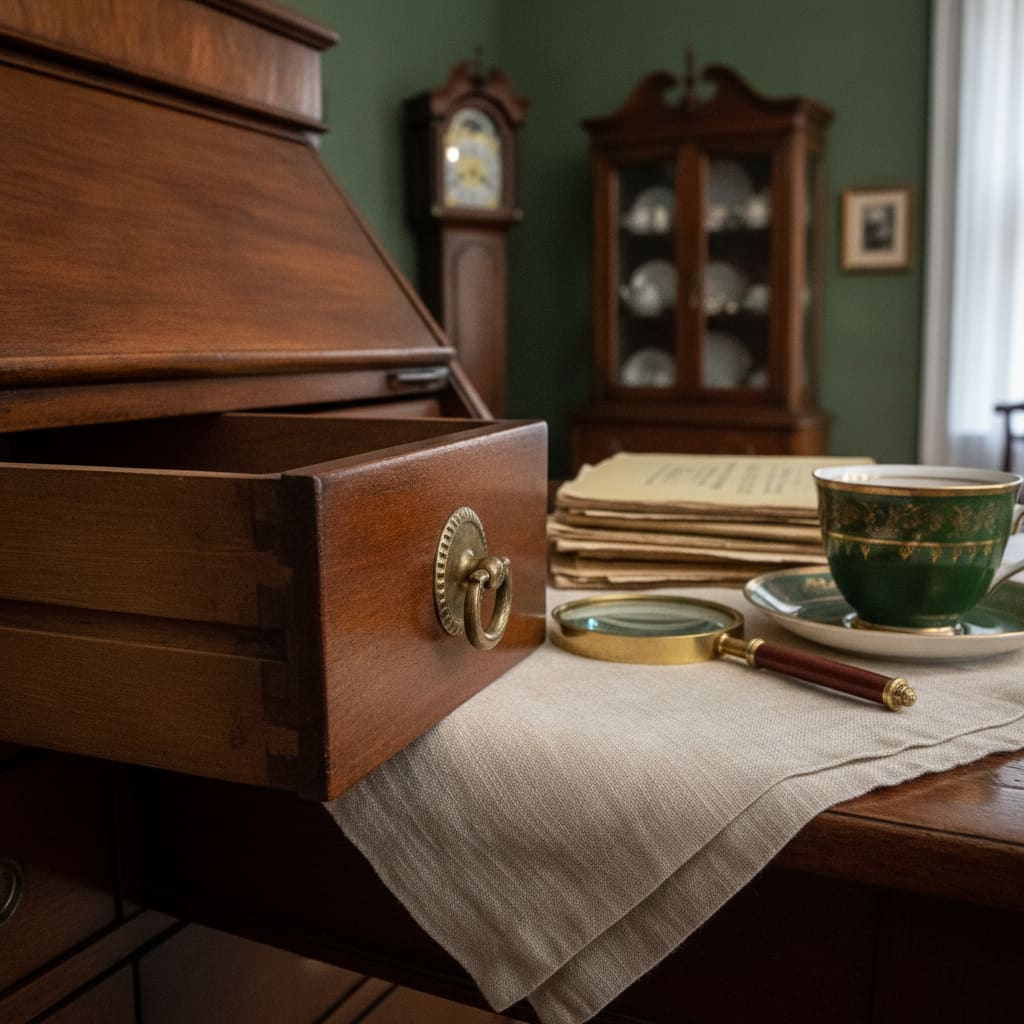
The fastest way to date a chest, dresser, or desk is to pull out a drawer and look at its corners. Dovetail joints — the interlocking fan-shaped pins and tails that hold drawer sides together — changed in distinctive, well-documented ways as furniture making moved from hand tools to machinery. One glance at the joinery can separate a genuine Georgian chest from a 1920s revival piece, and a Victorian original from a modern reproduction.
Why Drawer Joints Tell the Truth
Furniture styles get revived constantly: Chippendale forms were reproduced in the 1870s, the 1920s, and are still made today. Surfaces get refinished, hardware gets swapped, and tops get replaced. But the humble drawer joint was never meant to be seen, so nobody bothered faking it — the maker simply used the fastest method available. That makes joinery one of the most honest dating clues on any case piece.
The rule of thumb: irregularity means age. Hand work is slightly uneven; machine work is perfectly uniform. Everything below builds on that principle.
The Dovetail Timeline
| Approximate era | Joint type | What you'll see |
|---|---|---|
| Pre-1700 | Single large dovetail or rabbet and nails | Crude, one or two big pins per corner |
| c. 1700–1790 | Hand-cut, wide pins | 2–4 tails per corner, thick pins, visible scribe line |
| c. 1790–1860 | Hand-cut, refined | Narrower pins, finer spacing, still slightly irregular |
| c. 1871–1900 | Knapp joint | Round "pin and scallop" pattern — looks like half-moons |
| c. 1890 onward | Machine-cut dovetails | Perfectly even, identical spacing; pins and tails equal width |
| Mid-1900s onward | Modern machine joints | Uniform dovetails, or dowels, staples, and rabbet joints in cheaper work |
Hand-Cut Dovetails (before ~1890)
A cabinetmaker sawing dovetails by hand leaves telltale evidence:
- Scribe lines — a fine scratched guideline across the drawer side where the maker marked the depth of the cuts. It was never sanded out because it sat inside the joint.
- Irregular spacing — tails vary slightly in width; angles differ a degree or two from one another.
- Slender pins — by the early 1800s, fine work featured pins that taper almost to a point, something early machines couldn't produce.
- Overcuts — tiny saw kerfs extending past the scribe line at the base of the joint.
Generally, the fewer and cruder the dovetails, the earlier (or more provincial) the piece; the finer and more numerous, the later and more sophisticated the shop.
The Knapp Joint (1871–1900): The Best Dating Clue in Furniture
In 1871 Charles Knapp patented a machine that cut a distinctive round joint — a circular pin locked into a scalloped socket, sometimes called the "pin and cove," "half-moon," or "scallop" joint. It dominated American factory furniture through the 1880s and 90s, then vanished around 1900 when machines that mimicked traditional dovetails took over (Colonial Revival taste demanded joints that looked hand-made).
That gives the Knapp joint an unusually tight window: if a drawer has half-moon joinery, the piece was almost certainly made between 1871 and about 1900, and it is American factory production — typically Eastlake or Renaissance Revival walnut and oak. Few dating clues in all of antique furniture are this precise.
Machine-Cut Dovetails (after ~1890)
Once you see dovetails with perfectly identical size and spacing — pins and tails the same width, angles dead-equal — you're looking at post-1890 factory work. That doesn't make the piece worthless; quarter-sawn oak dressers from 1900–1915 are honest antiques. But uniform dovetails on a "Chippendale" highboy tell you it's a 20th-century revival, priced accordingly.
Beyond Dovetails: Five More Drawer Clues
Corroborate the joinery with everything else the drawer shows you.
| Clue | Earlier work (pre-1860s) | Later work |
|---|---|---|
| Saw marks | Straight, parallel marks (pit or sash saw) | Circular arcs (circular saw, common after c. 1850) |
| Nails | Hand-wrought rose heads (pre-1800), square cut nails (c. 1800–1890) | Round wire nails (after c. 1890) |
| Screws | Off-center slots, irregular threads (pre-1850) | Uniform machine screws (after c. 1848); Phillips heads after the mid-1930s |
| Secondary wood | Local pine, poplar, oak; thick, rough-planed | Thin, uniform, sometimes plywood (20th century) |
| Wear and shrinkage | Boards shrunk across the grain; runners worn hollow | Flat, dimensionally perfect boards |
Two details deserve emphasis. Circular saw marks on drawer bottoms or backboards are close to disqualifying for a claimed 18th-century date — the circular saw wasn't in common furniture use until the mid-1800s. And plywood or fiberboard anywhere means 20th century, full stop, no matter how convincing the style.
Also check that all drawers match. Replaced drawers, married pieces (a top and base that started life separately), and re-veneered fronts show up as inconsistent joinery between drawers — a red flag that affects value more than honest wear does.
English vs. American Drawer Construction
If the style could be either British or American, the drawer itself often settles the question — useful because provenance affects both value and buyer pool.
- Drawer bottoms: English drawer bottoms typically run with the grain side to side and slide into grooved slips; American bottoms more often run front to back, chamfered on three edges and set into grooves in the sides and front, nailed at the rear.
- Dust boards: full horizontal panels separating drawers are standard in English case furniture and much less common in American work, where open webs of runners and kickers prevail.
- Secondary woods: English makers reached for oak and deal (imported pine); Americans used whatever was local — white pine in New England, tulip poplar in the Mid-Atlantic, southern yellow pine below Virginia. Secondary wood is one of the strongest regional fingerprints a piece carries.
- Drawer sides: fine English work often has thinner drawer sides with rounded top edges; American country work tends to be thicker and squarer.
None of these rules is absolute — makers emigrated and habits traveled — but combined with joinery style they usually place a piece on the right side of the Atlantic.
Reading Honest Wear
Age leaves wear exactly where use puts it, and fakers routinely get this wrong:
- Drawer runners should be worn hollow along the middle of their length, with matching wear on the case's runner strips. Crisp, square runners under a "Georgian" chest mean replacement or reproduction.
- Shrinkage happens across the grain, never along it. A genuinely old round tabletop measures slightly oval; drawer bottoms develop gaps or splits front-to-back on American pieces.
- Oxidation inside the case should be even and gray-brown. A drawer side that's bright and pale where it should be dark suggests re-cut or replaced timber.
- Tool marks under later surfaces: raking light across a drawer front's inside face should show subtle plane ripples on pre-machine work, not the glassy flatness of a thickness planer.
Uniform "distressing" — dents applied evenly everywhere, including places hands never touch — is the signature of modern faux-aging, not two centuries of use.
What This Means for Value
Joinery dating feeds directly into valuation. A chest with fine hand-cut dovetails, consistent secondary wood, and original surface can be a significant antique; the same silhouette with machine dovetails is a revival piece worth a fraction. The Knapp joint sits in between — genuinely antique Victorian factory furniture, collectible but abundant. Our antique furniture appraisal guide covers how construction, surface, and form combine into a value range, and the vintage furniture guide picks up the story for 20th-century pieces.
Photographing Joints for Antique Identifier
Pull the drawer fully out and photograph the corner joint in raking light (light from the side exaggerates the shadows in the joinery). Capture the drawer bottom's saw marks and any scribe lines too. Antique Identifier reads the joint pattern alongside the piece's style and suggests a period with an educational value range — and you can ask the AI Expert whether an odd detail, like mismatched joints between drawers, changes the story.
Frequently Asked Questions
Are hand-cut dovetails always older than machine-cut ones?
Almost always in factory contexts, but custom and artisan furniture makers still cut dovetails by hand today. Confirm with corroborating clues: scribe lines plus cut nails plus straight saw marks make a strong case; hand-cut joints with wire nails and plywood suggest a modern craft piece.
My drawer has no dovetails at all — is it old or cheap?
Either very early (pre-1700 work used nailed rabbet joints), very provincial, or 20th-century budget construction using dowels, staples, or machine rabbets. Let the wood, nails, and wear decide which.
What exactly does a Knapp joint look like?
A row of round pins, each nested in a half-moon scallop — collectors compare it to a row of suns rising over hills. It appears only on the drawer's back corners in some pieces, so check both front and rear joints.
Does refinishing hurt the value of a piece with great joinery?
Often, yes. Original surface is a major value component on early furniture. A refinished Georgian chest keeps its structural dating credentials but typically loses a meaningful share of its market value versus an untouched example.
Try Antique Identifier
Next time a dresser catches your eye at an estate sale, pull a drawer and take two photos — the corner joint and the front of the piece. Antique Identifier gives you a period estimate and educational value range on the spot.