
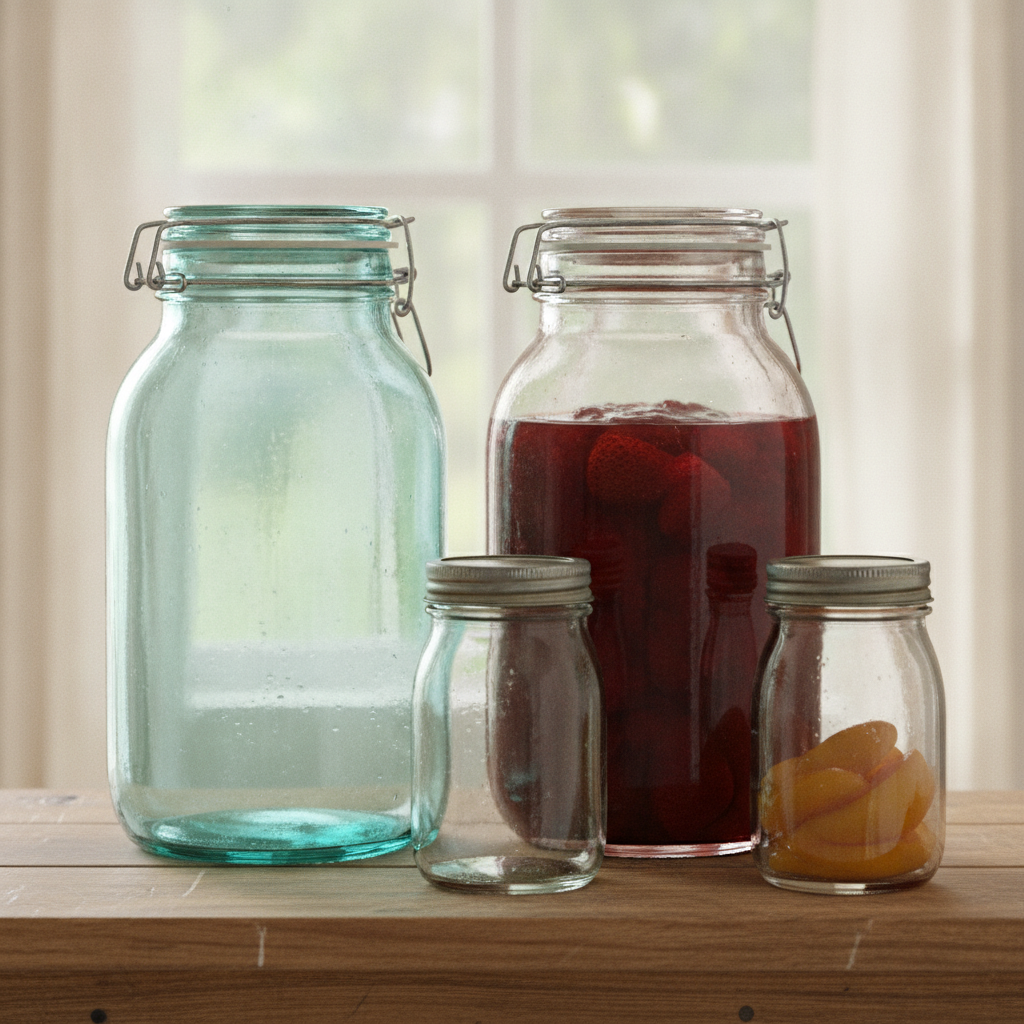
Atlas mason jars turn up in every barn, basement, and flea-market crate, and most of them are ordinary. A few are not. The name covers several decades of fruit jars made by Atlas and then by Hazel-Atlas, in clear glass and in colors collectors actually pay for, with closures that range from a common zinc cap to an early wire-bail lid. Value follows that combination — mark, shape, color, and whether the lid still seals — not the word "antique" on a tag. This guide shows how to place an Atlas jar in a date range and how to read educational price ranges before you buy a box of them.
Hazel-Atlas was a volume manufacturer, not a art-glass house. The company was formed in 1902 when the Atlas Glass Company and Hazel Glass Company combined, and it became one of the largest makers of packer ware and home-canning jars in the United States until the mid-1960s. Jars marked Atlas were made across that long run. A clear standard mason from the 1940s and a colored E-Z Seal from the early years can sit side by side and differ in price by an order of magnitude. The job is to tell them apart.
If you already date Ball jars, keep that chart separate. Atlas and Ball shared the fruit-jar market and sometimes similar wording, but the logos, shoulder shapes, and base marks are different. Our Ball mason jar dating guide covers the cursive Ball logos. This page is only Atlas and Hazel-Atlas.
Which Atlas Jar You Actually Have
Start with the embossing on the front and the way the jar closes. Those two facts sort almost every Atlas jar into a family.
Atlas Mason. Block or simple lettering reading ATLAS above MASON, usually on a standard shouldered jar. These are the common twentieth-century canning jars. Many also carry "Mason's Patent Nov 30th 1858." That date is the old Mason patent, reused for decades as a design label. It does not mean the jar was made in 1858. Atlas as a jar brand is a twentieth-century product.
Atlas Strong Shoulder Mason. The shoulder — the curve between the neck and the body — is thicker and more squared than on a standard mason. Hazel-Atlas promoted the strong shoulder as a jar that resisted cracking when you tightened a lid. Most examples are clear and date from roughly the 1920s through the 1940s. They are recognizable in a crate without reading the logo, which is why dealers pull them out first.
Atlas E-Z Seal. A wire-bail jar with a glass lid, not a screw band. The front is embossed ATLAS E-Z SEAL. The bail clamp is the closure. These are earlier than the everyday screw-top mason and are the Atlas jars most likely to be worth more than pocket change when the glass lid and wire are original and intact. Production is generally placed in the early 1900s into the 1920s; treat any tighter date as approximate.
Hazel-Atlas mark. On the base, or sometimes the side, look for an H set over an A, often read as the Hazel-Atlas monogram. That mark dates the piece to the Hazel-Atlas years, about 1902 to 1964, and it appears on jars, packer bottles, and table glass. A monogram alone does not make a jar rare. It tells you the maker and rules out a modern reproduction that only borrowed the word Atlas.
Photograph the front logo straight on, then the shoulder profile, the closure, and the base. Glare on embossed glass hides the letters. Tip the jar until the letters throw a shadow.
Atlas and Hazel-Atlas Dating Chart
Ranges below are approximate. Molds stayed in service, and wording overlaps. Use them to land in the right era, not to name a month.
| What you see | Approximate era | Closure | How common |
|---|---|---|---|
| Atlas E-Z Seal, wire bail, glass lid | c. 1900s–1920s | Wire bail | Less common; check that lid and wire match |
| Atlas Mason, standard shoulder | c. 1910s–1950s | Screw band, often zinc or glass insert | Very common in clear glass |
| Atlas Strong Shoulder Mason | c. 1920s–1940s | Screw band | Common in clear; colored examples matter |
| Hazel-Atlas H-over-A monogram | c. 1902–1964 | Varies | The maker's mark, not a rarity mark by itself |
| "Mason's Patent Nov 30th 1858" | Used for decades after 1858 | Usually screw | A patent slogan, not a manufacture date |
A few other clues help when the logo is worn. Aqua glass is more often earlier than a bright water-clear jar, but color alone is not a date. Machine-made jars have a mold seam that runs through the lip area; earlier mouth-blown jars usually show a ground lip or a different seam stop. Most Atlas masons you will meet are machine-made. Zinc caps with a milk-glass liner, and later two-piece metal bands with a flat lid, track the same change every American canning jar went through. A jar sold "with lid" should have the closure that belongs to its type. A screw band on an E-Z Seal is a replacement story, not original equipment.
Base numbers are mold numbers. They identified the mold for the factory. They are not years, and a low number is not a scarce edition.
What Atlas Mason Jars Are Worth
Prices below are educational estimates for intact jars in the U.S. collector market, not appraisals and not what a picker is required to pay. Chips on the lip, cracks, and heavy interior stain ("sick" glass) cut value sharply. A rare color with a damaged sealing surface is often worth less than a common jar you can still display.
| Jar, typical condition | Educational value range |
|---|---|
| Clear Atlas Mason, quart, ordinary logo | $4–12 |
| Clear Atlas Strong Shoulder Mason | $8–25 |
| Clear Atlas E-Z Seal with original glass lid and wire | $18–50 |
| Aqua Atlas mason or E-Z Seal | $20–70 |
| Amber, olive, or other deliberate color | $50–200, more if the color is strong and the jar is undamaged |
| Half-gallon sizes in desirable color | Often above the quart price for the same color |
| Jars with mismatched or missing closures | Discount the range; the closure is part of the object |
Clear strong-shoulder quarts are the jars people hope are valuable because the shoulder looks "old." In clear glass they are a staple, not a prize. Pay attention when the glass itself is the feature: real amber, olive, or a deep aqua that is consistent through the thickness, not a stain on the inside. Sun-colored purple from manganese glass that sat in a window is a different case. Collectors often treat that purple as later alteration, and many will not pay a color premium for it.
Regional flea-market prices sit under sold prices at specialist bottle shows. If a tag says $80 for a clear strong-shoulder quart, you are looking at a story, not the market. Our antique price guide explains how to separate asking prices from prices people actually pay.
Closures, Color, and the Mistakes That Cost Money
The lid is half the identification. An E-Z Seal wants its glass lid and the wire bail that clamps it. A mason wants a band and a lid, or an older zinc cap, that fits the bead at the lip. Replacements are normal on jars that were used. They are also the reason a "complete" jar should be checked: a new two-piece lid on an early bail jar means you are pricing the glass only.
Color needs light, not a listing photo with a filter. Hold the jar to a window. Clear glass stays neutral. Aqua shows a green-blue tint in the thickness at the base. Amber is brown through the glass, not a dirty interior. Interior milkiness that does not change when you rinse the jar is damage, often called sick glass, and it belongs in the condition note, not in the color note.
Embossing should be read, not guessed from a silhouette. "Atlas" on a modern decorative jar, a painted label, or a reproduction sold as kitchen décor is not Hazel-Atlas. Reproductions usually lack a crisp mold seam, a proper base mark, and the weight of a real canning jar. If the glass feels thin and the letters look printed rather than raised from the mold, stop.
Antique Identifier is built for this first pass. Photograph the logo, the shoulder, and the base, and the app helps you sort maker, closure type, and an educational value range before you commit to a box of jars. It does not replace a specialist for a rare color, and it should not be asked to. Use it to drop the common clear quarts quickly and to document the jar you think is amber.
For camera setup on shiny embossing, the guide to identifying antiques by photo covers angle and glare. The same method works on jars, bottles, and porcelain marks.
Buying and Selling Atlas Jars
At a sale, sort the box before you negotiate. Pull E-Z Seals, any non-clear jar, and anything with an unusual embossing you cannot read. Leave the clear standard masons unless the price for the whole box is trivial and you want them for storage or display. Ask to see lips and bases. A star crack in the base or a chip on the sealing rim is the defect that matters, and it is the one a top-down photo hides.
If you sell, say the size, the exact embossing, the closure you have, and the damage. "Antique Atlas mason, rare" is not a description. "Clear Atlas Strong Shoulder Mason, quart, no lid, small flake on the lip" is. Collectors pay for the second listing. Include a photo of the base monogram if it is there. That single picture answers the Hazel-Atlas question.
Do not can food in these jars. Lips wear, hairline cracks hide in old glass, and vintage closures are not a modern seal. Keep them for display. That also protects a colored jar you might otherwise scratch in a dishwasher.
Frequently Asked Questions
Are Atlas mason jars worth anything?
Common clear Atlas and Atlas Strong Shoulder quarts are usually worth a few dollars to the low tens, not hundreds. Wire-bail Atlas E-Z Seal jars and genuinely colored jars — amber, olive, strong aqua — are the ones that move into higher ranges. Condition of the lip and whether the original closure survives matter as much as the name.
How do I tell an Atlas jar from a Ball jar?
Read the embossed name. Atlas jars say ATLAS, often with MASON, STRONG SHOULDER, or E-Z SEAL. Ball jars use the Ball script or block BALL logos covered in the Ball dating guide. A Hazel-Atlas piece may also show an H-over-A monogram on the base. Similar jar shapes do not mean the same maker.
Does "Mason's Patent 1858" mean the jar was made in 1858?
No. That line cites the nineteenth-century Mason patent and was molded into jars for decades afterward. Date an Atlas jar from the Atlas wording, the shoulder, the closure, and the Hazel-Atlas mark, not from 1858.
What is an Atlas Strong Shoulder jar?
It is a Hazel-Atlas mason with a thicker, squarer shoulder than a standard fruit jar, made mostly in the 1920s to the 1940s. Clear examples are common. The shoulder is a design feature, not proof of rarity. Color and condition decide the price.
Can Antique Identifier appraise my jar?
It can identify the likely type from photos — logo, shoulder, color, closure — and give an educational value range. That is a first pass for a flea-market box, not a formal appraisal. For an unusual color or a jar you plan to insure or sell at a specialist price, use the photos as documentation and ask someone who handles fruit jars in person.
Try Antique Identifier
Point your iPhone at the embossed front, the shoulder, and the base. Antique Identifier helps you separate a common clear Atlas mason from an E-Z Seal or a colored Hazel-Atlas jar, and it keeps the photos with your notes so you are not pricing from memory in the parking lot.