
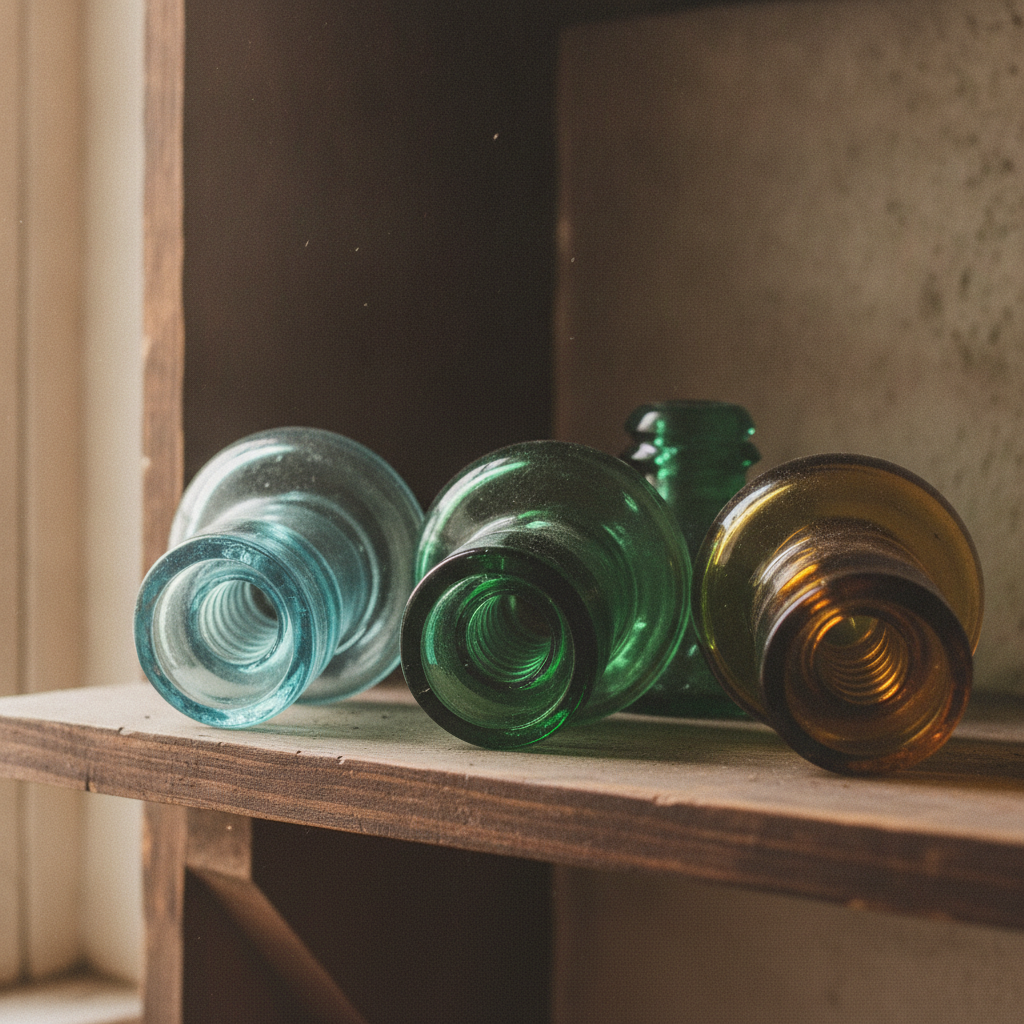
Glass insulators are the glass hats that kept telegraph and telephone wire off a wooden pin. Millions were made, most of them aqua or clear, and most of those are worth a few dollars. Value jumps for threadless pieces, for unusual colors, and for scarce shapes. It does not jump just because the glass looks old or because a patent date from the 1890s is embossed on the skirt. This guide shows how to separate the common Hemingray from the insulator worth carrying home, and how to read educational price ranges before you trust a tag.
If you already sort fruit jars, the habits transfer. Patent dates are floors, color is chemistry, and a number molded in the glass is almost never the year. Our Ball mason jar dating guide makes that case for jars. Insulators have their own marks.
What You Are Looking At
A pin-type insulator has a crown (the dome), a wire groove around the side, and a threaded or unthreaded hole underneath that sat on a wooden pin. Inner skirts, called petticoats, lengthened the path electricity would have to leak across wet glass. One skirt or two, a tall beehive profile or a squat signal style — those outlines are how collectors file shapes.
They are industrial glass, not art glass, even when the color is beautiful. Hemingray, Brookfield, and a crowd of smaller houses produced them from the mid-nineteenth century into the mid-twentieth, for telegraph, telephone, power, and railroad signal lines. Age is common. Scarcity is a particular combination of shape, embossing, and color.
None of this glass belongs back in service on a live line. These are collectibles. Old glass hides cracks, and a pole insulator is not a household part. Identify them, price them, and leave the wiring to equipment made for it.
Threadless and Threaded: The First Split
Threadless insulators have a pinhole with no screw threads. They were tied onto the pin, often with a cloth wrap and tar, in the early decades of the American telegraph. Production concentrates in the 1850s and 1860s, fading as threaded pins took over. Threadless glass is a minority of what you will see, and as a class it is worth more than ordinary threaded aqua. Chips still hurt. A threadless insulator in a scarce color is a specialist's object, not a five-dollar pole find.
Threaded insulators spread after the mid-1860s, once threaded pins and threaded glass became the standard. Almost every insulator at a flea market is threaded. Threads do not make a piece new. They make it part of the long production that runs from the late nineteenth century through the 1940s and, for some styles, later. Within threaded glass, the maker, the style number, the drip points, and the color do the dating.
The split is something you can feel with a finger in the pinhole. Ridges mean threaded. A smooth hole on a convincingly old piece of glass means stop and look harder. Do not force a price in the parking lot if you are not sure which you are holding. Photograph the pinhole with a light behind it.
Maker Marks Worth Reading
Hemingray is the name you will see most. The company made insulators for decades, in Cincinnati and later in Muncie, Indiana. Embossing runs from early "H.G. CO." style marks to the familiar script or block "Hemingray," often with a style number such as No. 9, No. 12, or No. 42, and often with a patent date. Hemingray No. 42 and Hemingray No. 9 are among the most common American insulators. In aqua or clear, with no damage, they are beginner glass: fine to own, wrong to price as rare.
The patent date May 2, 1893 refers to Hemingray's drip points, the little points around the base that were meant to shed water. That date stayed in the molds for decades. A Hemingray-42 embossed with May 2, 1893 was not necessarily made in 1893. It was made sometime after the patent, often well into the twentieth century. Sharp drip points are the earlier form. Rounded drip points are later, a change collectors place around the early 1920s. "Made in U.S.A." on a Hemingray piece points to later production as well, commonly the 1930s and 1940s.
Brookfield, of New York, is the other name beginners should learn. Marks read Brookfield, W. Brookfield, or a simple B, depending on the era. Brookfield aqua is common. Brookfield in odd colors, or in scarce shapes, is a different shelf.
Other American names show up often enough to recognize and not often enough to memorize in one afternoon: Whitall Tatum (the same Millville house that marked druggist bottles), Gayner, Lynchburg, McLaughlin, California houses, and a long list of smaller works. Canadian pieces (Dominion and others) and later foreign insulators have their own collectors. In the United States market, a no-name foreign piece in ordinary aqua usually trails a scarce American color. Identify the country before you compare prices.
Style numbers are the company's catalog. CD numbers are something else. CD stands for Consolidated Design, the collector shape system associated with N.R. Woodward. A CD number describes the outline — dome, wire groove, skirts — and the same CD shape can be made by several companies. The number is not a mold code, not a date, and not stamped as a factory rarity rank. When a seller says "CD" and a price, they should be able to show which profile they mean. If you are learning, match the silhouette to a CD chart instead of trusting the number on a sticky note.
| Clue on the glass | What it supports | What it does not mean |
|---|---|---|
| Smooth, unthreaded pinhole | Likely threadless, mostly 1850s–1860s | Not a price by itself if damaged or misidentified |
| Screw threads in the pinhole | Threaded era, from the late 1860s onward | Not "modern" and not "worthless" |
| May 2, 1893 on Hemingray | Made after that drip-point patent | Not made in 1893 specifically |
| Sharp drip points | Earlier Hemingray, roughly 1890s–early 1920s | Not a rare style if the color is common aqua |
| Round drip points | Later Hemingray, from about the early 1920s | Not a reason to discard it; color still rules |
| "Made in U.S.A." | Tends toward 1920s–1940s production | Not a commemorative, and not automatically common in odd colors |
| Style number (No. 42, No. 9) | The maker's model | Not a rarity grade |
| CD number (from a chart, not the mold) | Collector shape class | Not a date or a factory serial |
Color Is Where Threaded Prices Move
Aqua and clear are the volume colors. Hemingray's blue-aqua, a bit deeper than jar aqua, is still a standard color on standard shapes. Light green and common green belong in the same everyday group on many CDs. You can build a windowsill of them and spend less than a dinner out.
The premiums sit in colors the factories made in small gathers or by accident. Amber, olive amber, cobalt and other true blues, peacock and teal shades, and two-tone pieces (two colors in one gather, often a clear or aqua zone beside green or amber) are the categories where collectors slow down. Shade names get poetic — root beer, honey amber, 7-up green — and the poetry is not the price. The price is how rarely that shade occurs on that shape, and how clean the glass is.
Sun-colored amethyst, the purple cast manganese glass picks up from years of ultraviolet light, shows up on insulators the way it shows up on bottles. A light purple on a common threaded shape is a nice object and a modest one. It is not cobalt. Cobalt is blue glass through the body, made that way in the pot. If you are unsure, look at a thin edge. SCA purple is a stain of sun on glass that was meant to be clear or pale. Cobalt is color in the melt.
Carnival and odd smoky tones need the same caution collectors bring to jars. Some iridescent or intensely purple insulators were irradiated to shift the color. Altered color is collected by some people and discounted by others, and it should be sold as altered. Our bottle guide makes the same distinction for manganese medicines: antique bottle identification separates sun color from a story that the purple is how the glass left the factory.
| Color on a common threaded shape | How collectors usually treat it |
|---|---|
| Aqua, Hemingray blue-aqua, clear | Everyday; low prices unless the shape is scarce |
| Common greens | Still ordinary on many CDs |
| Light sun-colored purple | Modest premium over clear on the same shape |
| Amber and olive | Real premiums; shade and CD both matter |
| Cobalt and strong factory blues | Strong premiums; top shades on scarce CDs can be serious money |
| Two-tone | Desirable when the split is obvious and original |
| Irradiated carnival or artificial purple | Price as altered, not as a rare factory color |
Scarce shapes change the table. A common color on a genuinely rare CD can beat a pretty color on Hemingray-42. That is why the shape chart exists. Until you can tell a rare profile from a common signal insulator, pay rare-color prices only for colors you can recognize, on glass you can see is undamaged.
Damage, Drip Points, and the Base
Insulator condition is about the skirt and the wire groove as much as the dome. A flake on the base, where the piece sat on a pin, is often called a "pin flake" and hurts less than a chip on the skirt or a chip that breaks the wire ridge — but it still hurts. Collectors say mint for no chips at all, and they mean it. Cracks, even internal heat checks, take a piece off the serious market.
Drip points should be counted and looked at, not just admired. Missing or chipped points are damage. Sharp versus round is a dating clue, described above, and it is also a place flakes hide. Run a finger gently under the points.
Bubbles, a bit of waviness, and small manufacturing stones in the glass are production. They are not cracks. A crack catches light as a flat plane. On expensive colors, photograph any inclusion before you buy so "mint" means the same thing to you and the seller.
Embossing should be readable. Weak letters can mean a worn mold, which is a production fact, or they can mean the glass is worn from weather. Weathered, cloudy surfaces from decades outdoors lower prices the way sick bottle glass does. Some collectors like honest pole wear. The price list assumes they like it less than mint glass.
Educational Value Ranges
These are typical asking prices in the United States collector market for the kinds of insulators people actually find. They are educational estimates, not appraisals. Scarce CD and color combinations move far above the bottom rows, and damaged glass falls toward the top rows even when the color is good. Sold prices often close under the ask. Read this table as a sorting tool, then check recent sales for the exact embossing and shade. The antique price guide explains how to weigh those comps, and what is my antique worth covers choosing a number for a sale versus a number for insurance.
| Insulator | Educational estimate |
|---|---|
| Hemingray-42 or No. 9, aqua or clear, no damage | $1–8 |
| Common Brookfield or no-name aqua, threaded | $3–15 |
| Light sun-colored purple, common shape | $10–40 |
| Better green or blue-aqua on a less common shape | $15–75 |
| Amber Hemingray or Brookfield, attractive shade, common-to-mid CD | $40–250 |
| Cobalt, common threaded CD, mint | $75–400, shade dependent |
| Two-tone, obvious and original, decent shape | $50–300 and up |
| Threadless, common form, undamaged | $75–500 |
| Rare CD or top color (cobalt, amber) in mint condition | Hundreds to several thousand; famous pieces go beyond |
A chipped skirt moves a piece down harder than a small base flake. A repaired insulator — glued chips, painted color — belongs near the bottom of its row or off the table. If someone has ground a base flat to hide damage, you are buying the damage.
Threadless prices in the table assume you are sure the pinhole was made that way. A threaded insulator with the threads broken out is damaged threaded glass, which is a very different object.
Altered Color, Commemoratives, and Mixed Parts
Three mix-ups account for most bad buys.
Irradiated or baked color. Intense carnival iridescence, odd smoky gray, or a purple that looks dyed onto a common clear shape can be later alteration. Factory amber and factory cobalt have a long paper trail on known CDs. A color you cannot find in any reference for that embossing is a reason to pause, not a reason to pay a premium for "one of a kind."
Commemorative and later glass. Souvenir insulators, paperweights, and modern reproductions copy the look of a crown and a wire groove. They may be solid glass with no pinhole, marked with a recent date, or molded in colors no telegraph crew ever hung. A real pin-type insulator is hollow to the threads or the threadless hole. Solid "insulators" sold as desk ornaments are a different product.
Storywear. A genuine Hemingray-42 does not become an 1893 survivor because the patent date says so, and it does not become rare because it came off a barn. Provenance is pleasant. Embossing, shape, color, and chips are the price.
When the color, the maker, the drip-point style, and the wear tell one story, use the table. When they conflict, price the ordinary explanation. The ordinary explanation is usually the true one, and it is the one a careful buyer will use against you if you overpaid.
Photographing an Insulator for Antique Identifier
You need five frames: the front embossing in raking light, the base so drip points and any mold line show, the pinhole so threads are visible, a side profile for the CD shape, and a shot with a thin edge lit so the color reads true. Flash glare on aqua glass hides letters the way it hides embossing on a bottle. Turn the piece until the letters shadow.
Antique Identifier can suggest a likely maker, era, and educational value range from those photos. Use AI Expert for the question you are actually asking — "are these drip points round or sharp?" or "is this color aqua or a better blue?" — and keep the set in the Collection Cabinet next to the next Hemingray you find. After a few dozen, the common No. 42s become obvious and the odd color is what you still bother to shoot.
For anything priced like a rare CD, get off the app and onto recent sales of that exact embossing and shade. Photo identification is a filter. A formal appraisal is for the piece you intend to insure or sell as a four-figure insulator, once the CD and the color are not in doubt. Camera setup for embossed glass is covered in the photo identification guide.
Frequently Asked Questions
Are Hemingray-42 insulators valuable?
In aqua or clear, with ordinary embossing, they are some of the most common American insulators and usually sell for a few dollars if they are undamaged. The same style number in amber, cobalt, or another scarce factory color is a different price. The patent date on the skirt does not change the aqua ones into 1893 rarities.
Does "May 2, 1893" mean my insulator was made that year?
No. That is the patent date for Hemingray drip points, and molds carried it for many years afterward. Use drip-point shape, "Made in U.S.A.," and the style of the name to narrow the decade. The patent date only tells you the glass was made after the patent.
What is a CD number?
CD means Consolidated Design, a collector's numbering system for insulator shapes. It describes the profile, not the year, and it was not a number the factory used as a serial. The same CD can exist in Hemingray, Brookfield, and other glass. Match your piece to a shape chart before you compare prices.
Are purple insulators rare?
Light purple from sun exposure on manganese glass is fairly common and usually modest in price on ordinary shapes. Deep cobalt blue is a factory color and is priced much higher. Intense carnival purple on a common clear style may be irradiated. Know which purple you have before you pay a rare-color price.
Do chips change insulator value?
Yes. Mint means no chips. Skirt chips and damage to the wire groove cut prices sharply. A small flake on the base is less serious and still visible to buyers who know the hobby. Cracks, glued repairs, and ground-down bases take a piece out of the range a mint example would bring.
Try Antique Identifier
Photograph the embossing, the pinhole, and the color at the edge of the glass. Antique Identifier turns that set into a likely era and an educational value range, so a common aqua Hemingray stays on the table and the odd color gets a second look.